Brief history of the village
The original settlement was at Salehurst which is described in the Domesday Book of 1085 as having “7 villagers and 8 cottagers, with 6 ploughs, a church and 16 acres” – it appears to be not much bigger now! The present church dates, in part, from the 12th century and contains some rare 14th century glass with drawings of birds and a 12th century font carved with salamanders said to have been given by King Richard 1st as thanks for the Abbott of Robertsbridge helping to raise his ransom when he was captured on his way home from the Crusades. In the graveyard there are table tombs with terracotta plaques by Jonathon Harmer.
Robertsbridge is not mentioned in Domesday but is now the main business and residential centre of the parish. The reason for this is the river Rother, or rather the bridge over it.
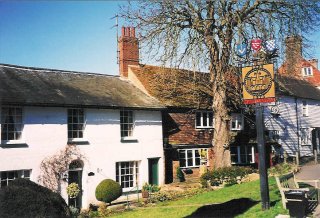
Sometime in the 12th century a Cistercian Abbey was founded within the parish of Salehurst on a site believed to be somewhere close to the present George Inn. At that time the usual method of crossing the river was by ford or ferry somewhere close to the church. Around the latter part of the 12th century the founder of the abbey, Robert de St. Martin, built a bridge over the Rother about a half mile west of the church; this was roughly where the present bridge known as The Clappers is located. At various times in the past suggestions have been made, notably by Hillaire Belloc, a frequent visitor to the village, that the name Robertsbridge is a corruption of Rother Bridge but two pieces of evidence seem to show conclusively that this is not correct. Firstly, the first mention of the name is in an abbey document from the 13th century which refers to Pons Roberti, the Latin for Robert’s Bridge and secondly, at the time of the bridge’s construction the river was known as the Limm!
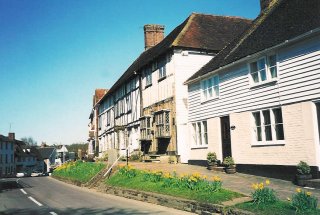
With most of the traffic by-passing the old village in order to use the new bridge, the centres of growth occurred around the northern and southern ends of the bridge and subsequently became the settlements of Northbridge Street and Robertsbridge. By the 16th century the basic layout of the village had evolved and this can be clearly seen in the many timber-framed buildings lining both sides of the High Street, which date from this period.
With the growth of the village, the abbey moved to site about 1 mile east of Robertsbridge and south of the river opposite the church at Salehurst. The remains of the abbey are on private land and the Abbott’s House dating from the 15th century is now incorporated into a private residence.
More information
More information can be found on the About Robertsbridge website. A collection of local history books can be viewed in the Parish Office or purchased from The Floral Boutique on Robertsbridge High Street. These have been produced by local historians which include the following titles:
- Who Lived Here – Robertsbridge
- Who Lived Here – Salehurst
- Who Lived Here – Northbridge Street
- Hodson’s Pocket Notebook
- A Salehurst Notebook
- Leaves from a Genealogists Notebook
- East Sussex Villages
If you are interested in local history you are invited to become a member of Robertsbridge and District Archaeological Society.